
Interview: Fanni Somogyi
Fanni Somogyi (b. Budapest, Hungary) is an emerging artist working in Bloomfield Hills, Michigan. Her work has appeared in notable two person exhibitions Sticky Entanglements with Beth Yashnyk at Transformer DC in 2023, and in Nature’s Take Over with David Szauder presented at Gallery Out of Home in 2024. Somogyi is an internationally exhibiting artist. Her work has also appeared in group shows at the Broom Factory (Detroit, MI), at Explora Salta (Salta, Argentina), at Target Gallery (Alexandria, VA), at Mother-in-Law’s Gallery (Germantown, NY), and at Vox Populi (Philadelphia, PA) among others.
Somogyi’s sculptures range in scale from tabletop pieces to large-scale installations, including a public sculpture in Washington DC, a temporary public sculpture at the Franconia Sculpture Park (Shafer, MN), and the traveling art installation Pop Sheep at Olala Street Festival (Linz, Austria) in 2018. She has been a resident at Franconia Sculpture Park, Torpedo Art Factory, and Annmarie Sculpture Garden. Somogyi was a Maxwell/Hanrahan Foundation Material Awards recipient in 2024 and 2025. Her education includes an MFA in Metalsmithing from the Cranbrook Academy of Art, an MA in Curatorial Studies from the Node Center in Berlin, and a BFA in Interdisciplinary Sculpture and Creative Writing from the Maryland Institute College of Art.
Read our interview with Fanni below!

Installation view of Emergence III in the exhibition “Miniatures: a Tiny Group Show” at The Nook, 2025
PP: Walk us through a typical day in your studio or generally through your process to make new work.
FS: An individual day in the studio varies widely. I tend to work on multiple projects at once because there are often waiting periods for the sculptures to set or grow. I work with various metals and use mold making techniques where I must wait for materials to cure. I usually begin a new work with an idea and rough sketches in my sketchbooks. Sometimes I also “discover” a new sculpture idea by having material lay around next to each other. I’m either chasing a form or a particular idea. Then I begin to work with materials exploring shapes in space, hot glueing things, taping things together temporarily just to see what it makes me feel when I walk around it. For my recent series of work, Molting, where I electroform copper and solder pipes into hybrid organic and industrial forms, I build up the form in the wax first. This medium is easy to manipulate and move around quickly. When I find the form that feels right, I cut it up and electroform the parts individually before soldering them back together and proceeding to sanding, polishing, and patinating.

Molting in the Current, Electroformed copper pipe and steel, 27 × 27 × 96 inches, 2025 (shown installed in “Muskeg” at Mother-in-Law’s Gallery)

Molting IV, Electroformed copper and copper pipe, 24 × 21 × 4 inches, 2025
PP: What motivates you to make art?
FS: I’m driven by curiosity and a love of making objects. If I’m not in the studio or making something with my hands for more than two weeks I become restless and melancholy. I’m a sculptor and I love playing with textures and materials. I’m happiest when I’m in the studio. There is something blissful when an object takes shape. I’m also thrilled by external research and conceptual explorations of my work. I’m currently thinking about architectural and bodily guttural systems, soft and hard infrastructures, and energy transfers. I often conduct research through walks, photography and reading. This multilayered approach continuously engages me because I learn and discover new things as I build my work.
PP: What is one goal you are aiming to achieve this year for your art practice?
FS: In May I completed an MFA in Metalsmithing at the Cranbrook Academy of Art. It was there that I began my electroforming series. Now that I have a bit more time on my hand, I hope to continue this exploration by building my own larger electroforming bath. This would allow me to create larger biomorphic sculptures and play with elements of growth and decay in the work. I hope to build at least 10 more medium sized sculptures before the year ends. As I’m building them, I’m thinking of ways that I could create an installation with them. I’m simultaneously thinking about opportunities where I could showcase them in 2026. I would like to also document these well and publish a short book with images and essays about my research.

Molting III, Electroformed copper and copper pipe, 26 × 20 × 8 inches, 2025
PP: What is your favorite medium and why?
FS: I’m currently obsessed with the electroforming process, which is an electric and chemical process of growing copper on non-metallic medium. The sculpture (the cathode) starts out as wax and is coated with a conductive paint and placed inside a copper sulfate solution bath. Then additional sheets of copper are placed in the bath; these are the anodes. Through an electrical current the copper particles migrate from the anode to the cathode growing the sculptures. This feels alchemical and magical, almost like a surrogate pregnancy as I grow my sculptures in the blue liquid. This process is mechanical and industrial, yet it mimics natural cycles of proliferation as well. I’m very drawn to the many possibilities of this medium.
PP: What role do you think artists have in society today? What role should they have?
FS: Artists are crucial in making us pause and think about things that we might on an ordinary day be not concerned with. They are essential in showing new and different perspective then our own. These works engage us in space and fascinate us through the material, formal and conceptual properties. I think artists should trigger our curiosity, make us wonder and sometimes shock us. Artists are also story tellers and they help give voice to marginalized voices.

Work in progress in Somogyi’s studio
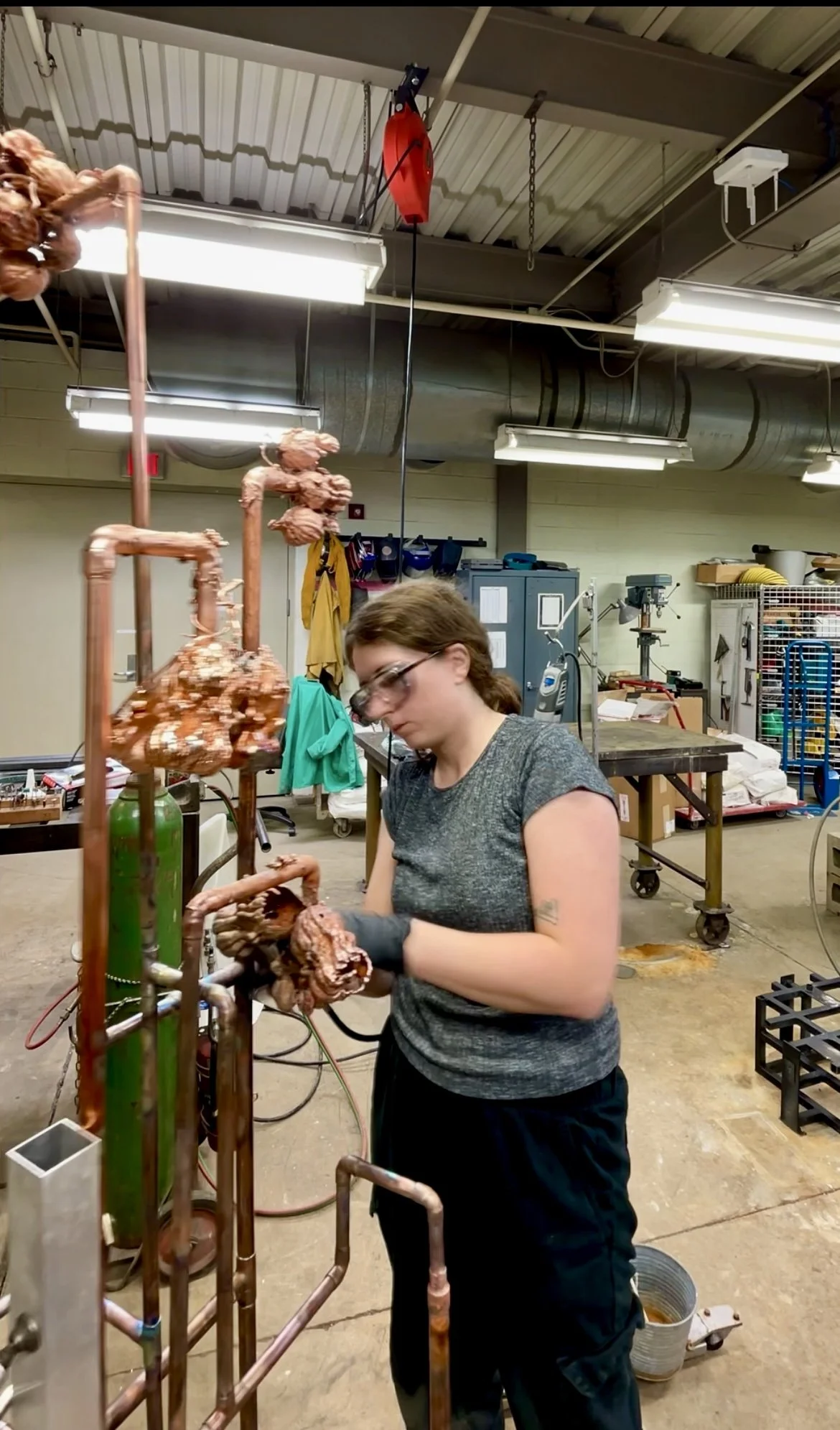
Somogyi working in her studio
PP: Who is a current muse for your practice? Could be anyone fictional or real, dead or alive!
FS: I’m currently inspired Astria Neimanis, a scholar and professor of feminist and environmental studies. I recently read her book “Bodies of Water: Posthuman Feminist Phenomenology” and I was absolutely blown away by it. It explores humanity’s relationship to oceans, watersheds and aquatic life forms while also highlighting our own bodies of water as ecosystems. As I was thinking about leaking bodies and our porous borders it was inspiring to read about her thinking, through her beautiful writing. I want to share one quote that has been on my mind for a couple of months now: “[...] as bodies of water we leak and seethe, our borders always vulnerable to rupture and renegotiation” and “[o]ur wet matters are in constant process of intake, transformation, and exchange [...].” This is from page 39 and to me it really highlights our fluid interconnected nature.
To learn more about Fanni’s work, see their Instagram and Website.