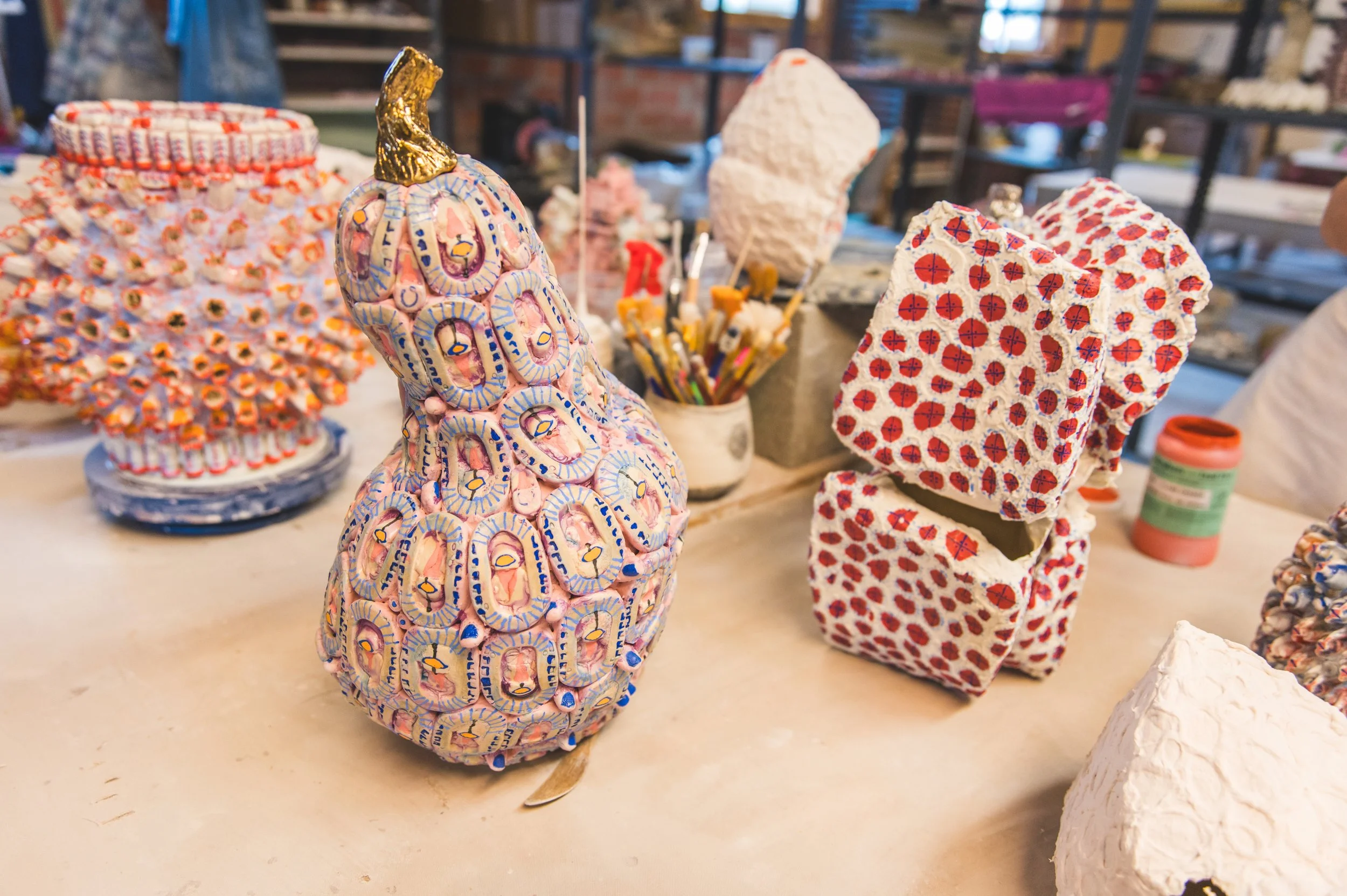
Interview: Kate Rusek
Kate Rusek (b. Newark OH) is a multi-disciplinary artist assembling highly tactile sculptures, textile, garment and instafflation with an emphasis on Craft and materiality. Rusek received an M.A from Savannah College of Art and Design and dual B.F.As from The University of Miami. Rusek has been awarded residencies at The Archie Bray Foundation, Socrates Sculpture Park, and Vashon AIR among others. She is the Devra Freelander Fellow at Socrates Sculpture Park for 2023 and the recipient of a Windgate Distinguished Fellowship for Innovation in Craft. She is a Daytime Emmy winner for her costume design on Sesame Street and has built a career as a bespoke fine Tailor, builder of couture and specialty costumes.
Select exhibition venues include Trotter and Scholer (NYC), The Vestibule (Seattle), Culture Object (NYC), Shelter Gallery (NYC), Geheim Gallery (Bellingham, WA), Socrates Sculpture Park (NYC), and Koulva Sullivan (Spokane, WA). Rusek splits her time between New York City and Bellingham, WA.
Influenced by man-made environmental catastrophes, emotional landscapes, and ecological systems, Kate Rusek assemble highly tactile sculptures transmuting these themes into lavish maximalism. Using large quantities of collected and constructed objects, these composite forms and dynamic biophilic textures interrogate socially constructed value and material narrative. Engaging with history laden excesses, Rusek shape scenes that examine the binary between the living and manufactured worlds with an emphasis on a somatic experience of Craft. Through a lens of deep time, particular interest is placed on synthetic and highly manufactured elements as an action to transform anthropogenic ruin into an counter-economic act of rebellion. Her work is a method to posit a regenerative future and pose questions about psychological perception, socially constructed value, and a broader care ethic through a lens of desire and abundance.
Read our interview with Kate below!
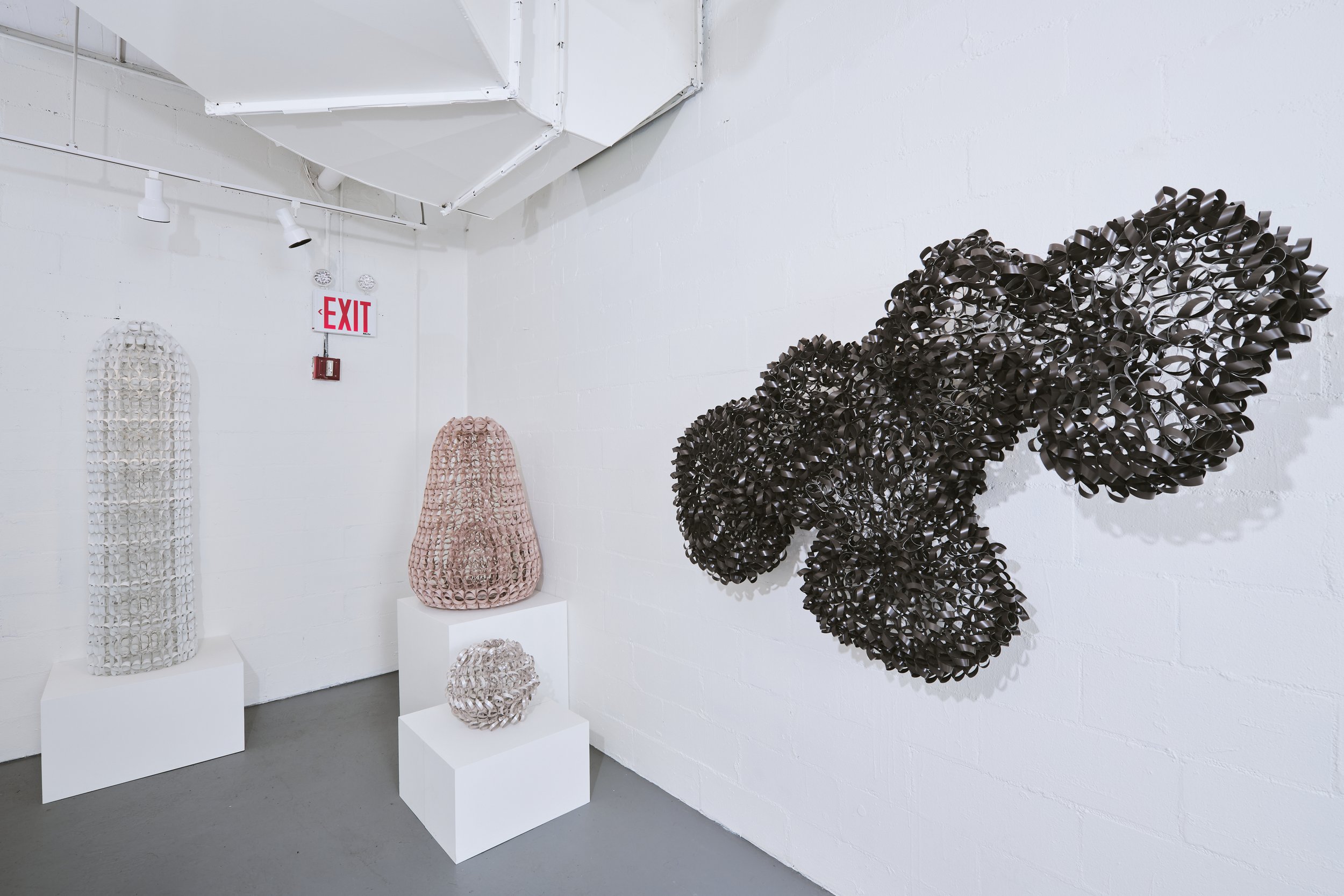
Installation view of the exhibition “Boundary Layer” at Materials for the Arts, 2024
PP: Walk us through a typical day in your studio or generally through your process to make new work.
KR: Typical days in my studio have become so varied it is hard to describe at this point. I work in several different sculptural mediums including ceramics, found objects, and textiles. What I am working on completely dictates my physical movements and to an extent my mental state when I am making. To start new work I am often pulling from a deep well of notes and research, recent books about the state of our planet, brand new biological research, relational conversations describing the functions of our brain and body connection. Many considerations on my mind to inform the contextual subject matter of the work to then tie to my actions and processes in the studio. In nearly all my work, there is a phase of pure experimentation; it's an opportunity to see and touch, understand how materials behave, how compositions or physical characteristics affect a form. From there I am typically working straight into a piece, allowing it to unfold, 'talk back' to me, and come into being without a lot of judgment. There is a lot of spontaneity to my work, yet it accumulates over time. I can work on a the repetitive nature of a surface or form for a few days and then stand back to evaluate what has taken place. I thrive in this sense of knowing and not knowing and trust that I will get to a destination eventually.

Reach, Porcelain, glaze, 16 x 16x 11 inches, 2024

Siphonophore for the In Between, Reclaimed vinyl, nylon, discarded acrylic, anodized aluminum, vintage lead crystal, 36 x 30x 12 inches, 2024
PP: What motivates you to make art?
KR: A sense of discovery seems to be a uniting motivation as I look at the last few years. I so often show up in the studio with a curiosity that is only satiated by doing. Materiality, the stuff of our lives and this planet is tremendously rich. I am in awe so often as I move about my day at the sheer wonder that is existence in its joys, and hardships, and routine. My eyes and a felt sensory experience of places and objects has really informed my taste in the questions that I bring to the studio. If that curiosity is the basis for dimensional artworks, these objects one can relate to with one's body, the language of abstraction can be pushed to nearly infinite psychological depths.
PP: What is your favorite medium and why?
KR: My favorite medium is the leftovers, the cast-aside, the proverbial pocket lint of our lives. I want my work to be of and about the world and for me there is no other more direct statement than recontexualization and abstraction. It opens up possibilities. Materials that fall thru the cracks, are left out of a system of meaningful recycling, and have made meaning for us, often in very intimate ways are just so juicy. Nearly all of my work streams from the afterlife of things, most often directly and more recently reproductions in porcelain. The dwelling in this afterlife points to a passage of time, from immediate moments to a nearly unfathomable deep time in the cosmos. Expansively, time might almost function as a primary medium for me as well. In much of my work, as a senes of decay, transformation, and renewal is at the heart of my inquiry.
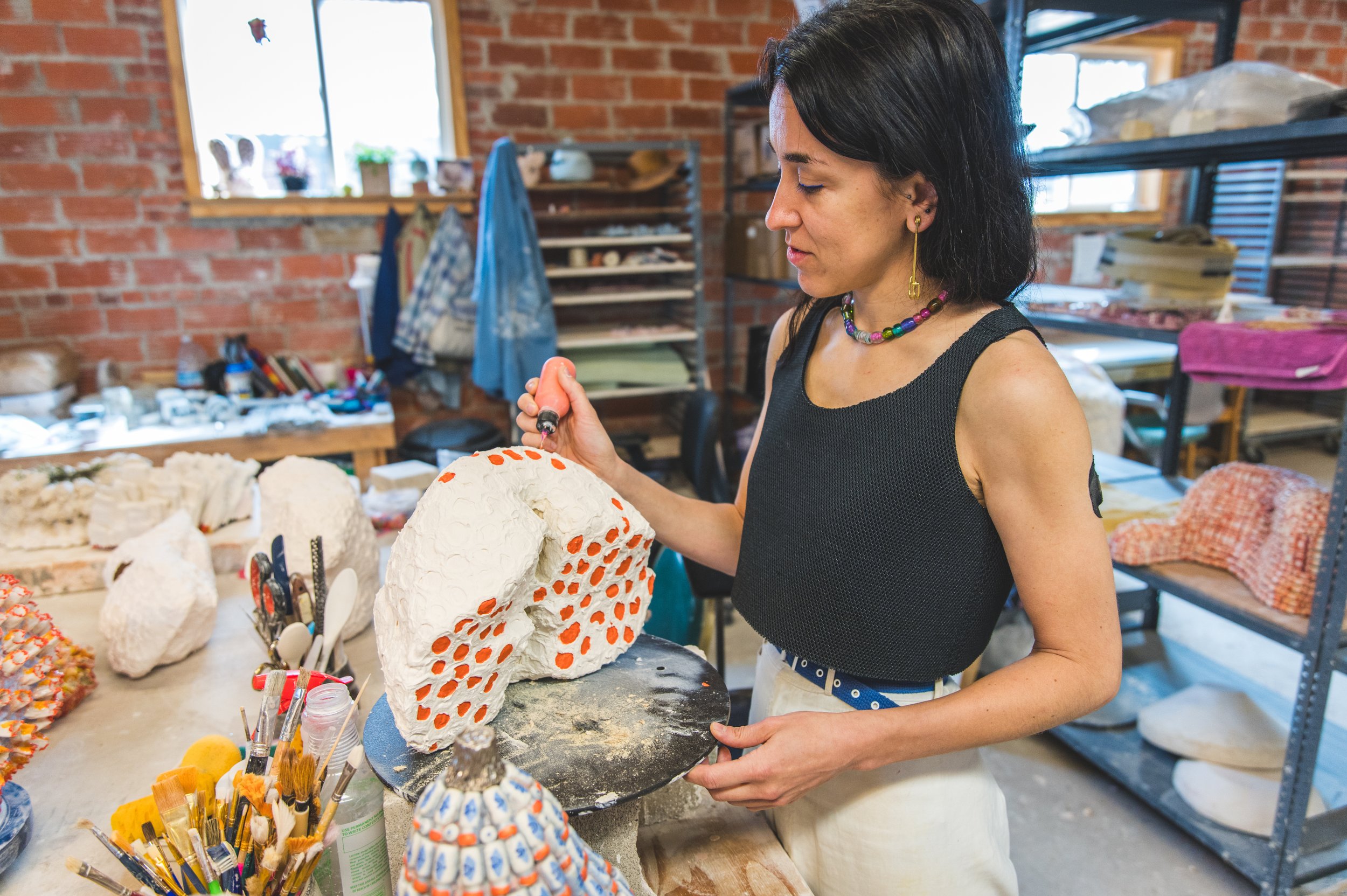
View of Kate working in the studio
PP: What would a dream project look like for you as an artist?
KR: I have been thinking a lot about dream projects lately. I like the idea of stragegic planning that balances my daydreaming experiments in the studio. I have had the privilege of completing a few larger public projects recently, namely as the Devra Freelander Fellow at Socrates Sculpture Park in 2023. Public art is dignity that human beings deserve. It is tremendously hard, complex work from the artist/practitioner side but it is also a means to expand in collaboration, community and vision. It would be a dream to continue this path, bring some of my outdoor work into public and semi public spaces like healthcare facilities and educational institutions. I want folks to meet my work when they might be challenged and seeking support in meaningful moments of their lives. Art has a very important role to play in stimulating the sensory experience of the world for everyone and I believe in this power. As an artist it is my aim to contribute meaningfully to cultural and social conversations within and beyond the art world. Art and artists need a certain amount of visibility in order to tap into the tremendous super powers we exercise through our perceptions, curiosity, and vision.
PP: Is community something you value in your practice? Why or why not?
KR: Community is a hearty reason I exist as an artist at all. On paper, the last few years have looked very transient, lots of residencies in landscapes that I love. However, a huge reason for putting my body and my work into these different spaces is the community I have the hope of finding there. It is pretty magical when artists are in 'conversation'; I mean of course that conversation runs the spectrum between actual chatting and adjacent solitude, working as neighbors with regular access to the depth of creation each one of us bring to our work. As I have understood how much other artists concurrent paths offer a mirror to my own, I am striving to bring all of my people with me on my journey. Whenever and however I can highlight or amplify the work of my dear hardworking friends, I am doing my best to do so.