
Valeria Divinorum is a Queens based visual artist and architect with formal training in the school of Architecture in Buenos Aires. She has attended residencies in Argentina and the US and has created works for a variety of contexts including galleries, live performances and site-specific installations. She is currently an Adjunct Professor of New Media Art at LaGuardia Community College and teaches art workshops at BronxWorks Senior Center. Recent exhibitions include Locus Amoenus (New York, NY), Light and Shadow Rethinking Visual Spaces (Bronx, NY), Solstice (Governors Island), I Break (Venice, Italy), El Hipercubo (Buenos Aires, Arg.) Space Light (LIC, NY), Illusional (New York, NY), Rear Vision (Madrid, Spain) and Bangkok Biennale (Bangkok, Thailand). She has created light-based sculptural installations at Griffin Sidewalk Studio in Lincoln Center’s David Geffen Hall (New York, NY), 100 Sutton Stidios (Brooklyn, NY) Chashama (New York, NY), Centro Cultural Voces del Sur (Buenos Aires, Arg.), The Plaxall Gallery (Queens, NY), Flux Factory (LIC, NY), The Wassaic Project (Wassaic, NY) and others. In 2013 she started her research of the process of Tiffany technique and the principles of sacred geometry with her mentor, Andres Jacob at Taller Escuela del Sur in Buenos Aires, Argentina. She is a member of the collective Salvia Divinorum, a recipient of the 2021 NYC Artist Corps Grant. Press for her work includes Harper's Bazaar, People en Español, NY Post, Stir, 440 Gallery, Time Out NY, NY1.com, among others. She has a passion for creating works for the public and with the public, to embrace connectedness and democratize art making for people in our community.
Valeria Divinorum’s work specializes in stained-glass sculptural objects which she uses as a lens to experiment with the intangible properties of light. She has a deep interest in exploring the optical perception of space through traditional and new media techniques, creating dispersion of light into spectral components. Her practice embodies light, shadows, finding new forms relating to spatial interaction by the interpretation of space into one single sculpture. A major theme in Valeria’s work is the human connection with nature and the organic expressions that emerge from that relationship.
Read our interview with Valeria below!
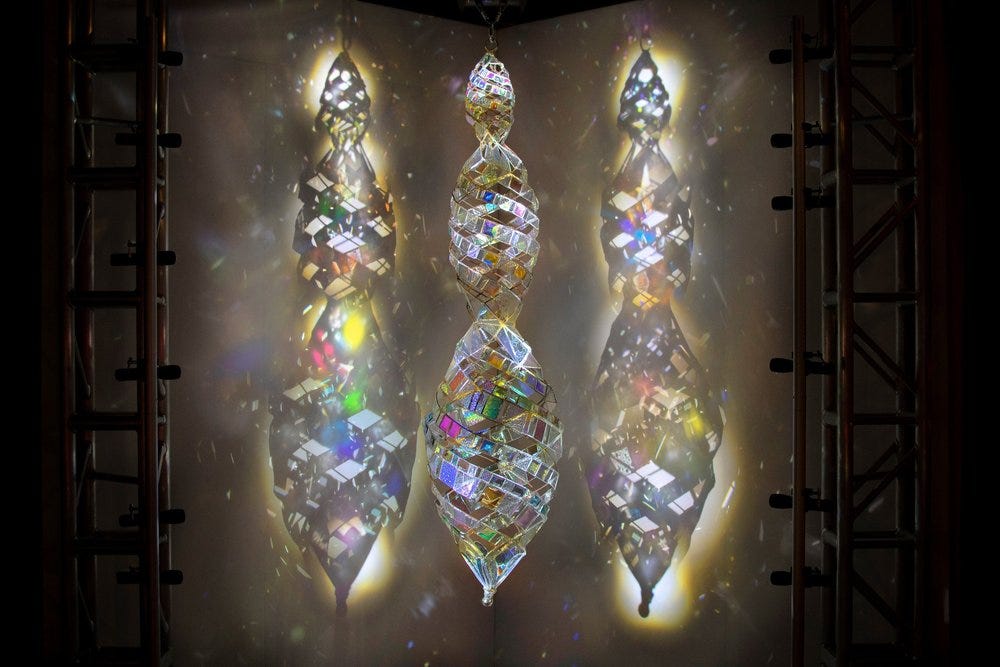
Installation view of Spiraculum in the exhibition “Locus-Amoenus” at the Lincoln Center, 2023
PP: Walk us through a typical day in your studio or generally through your process to make new work.
VH: I have a book of antique botanical drawings and I also buy a bunch of glass and start playing around with the combination of colors and textures. I make a mate (Argentine green tea), play some ambient chill music and then I start creating.
The sculptures I design are made using beveled, dichroic and iridescent glass sheets; materials that allow me to explore light refraction from different angles and surfaces generating new shapes though layers of light and color. I explore the dynamics between light, the laws of physics and matter to create new worlds though unique colorful shapes and ambient spaces of infinite optical layers.
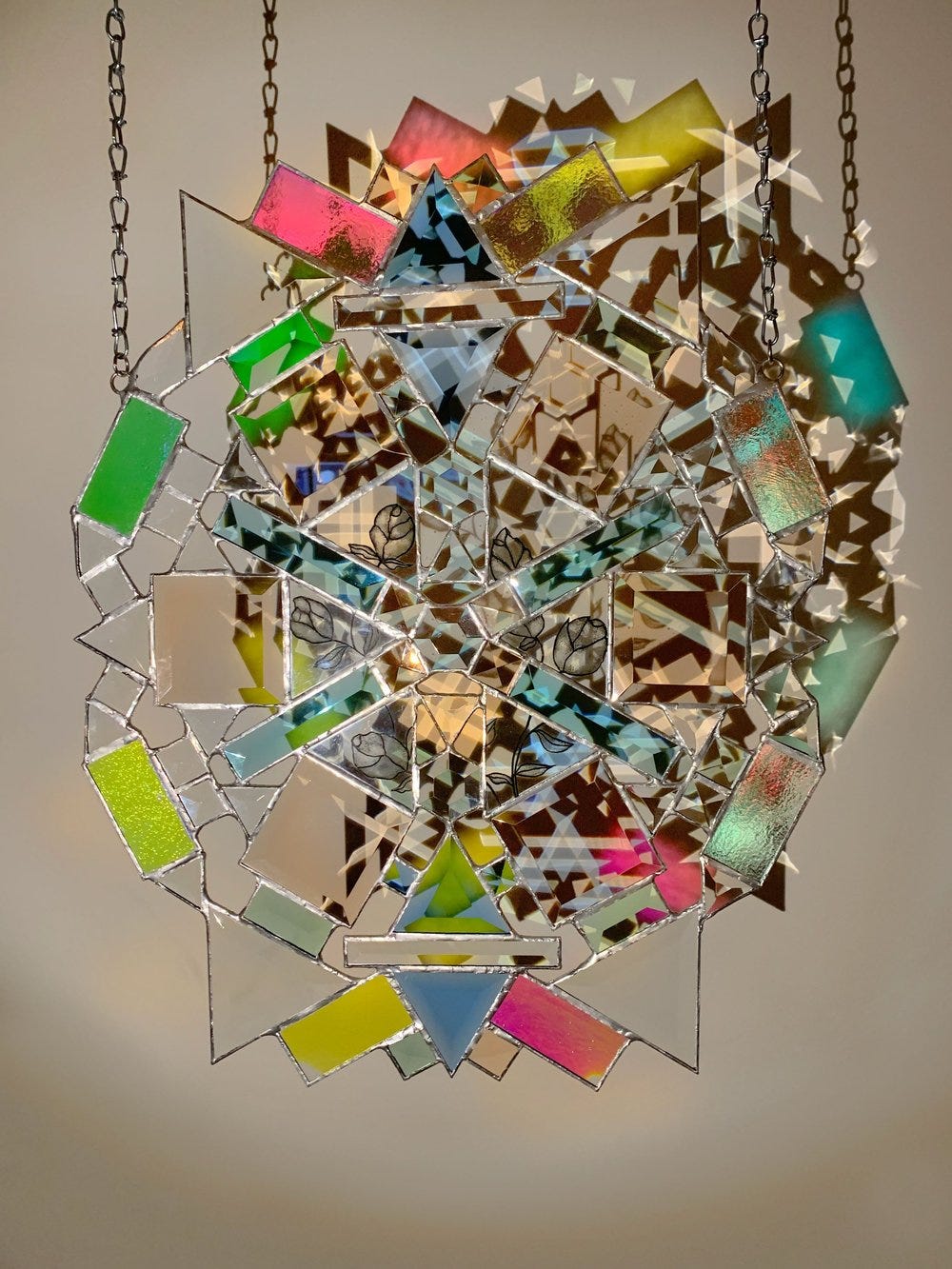
Oculus, Stained-glass, 20 × 15 inches, 2023
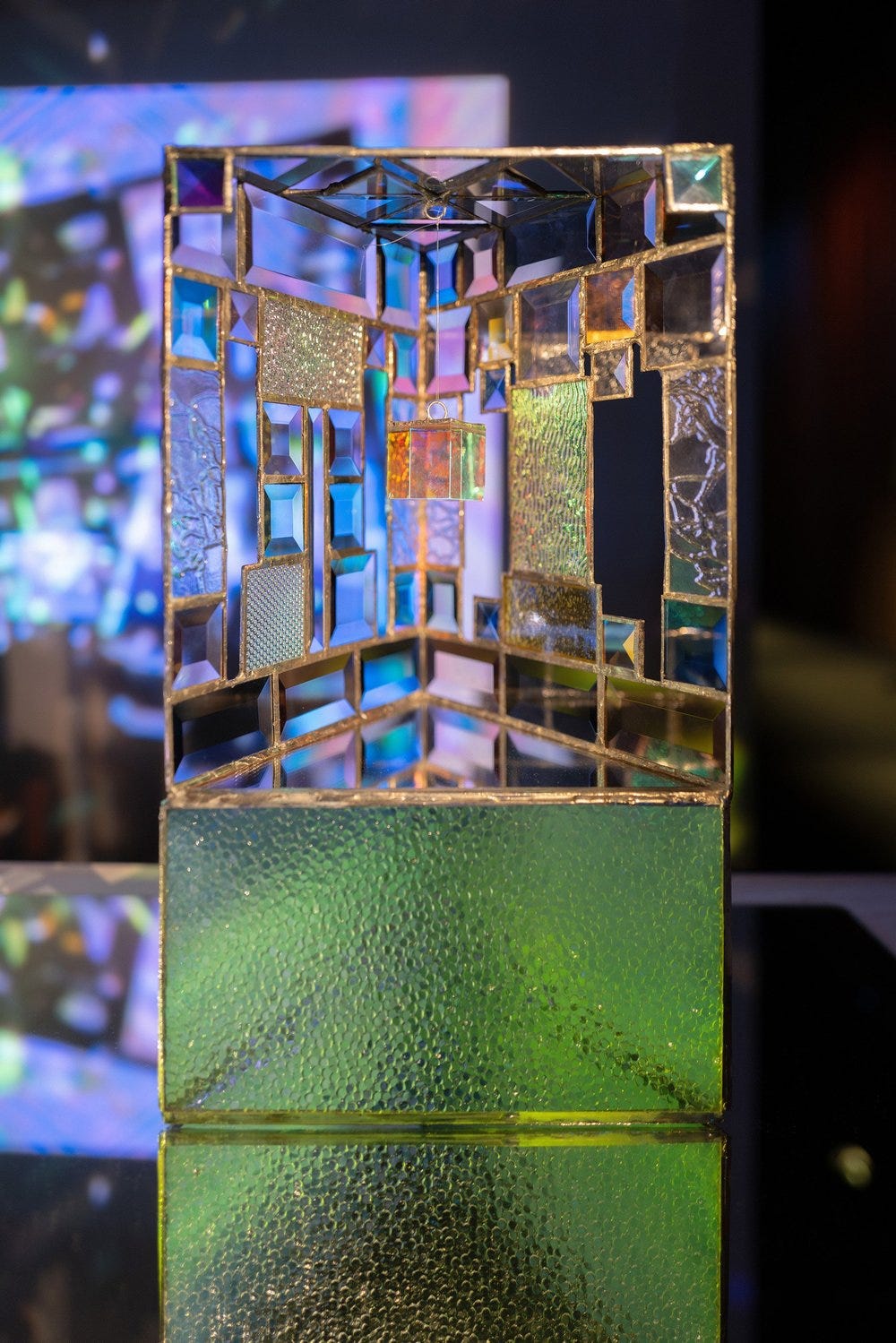
Trivium, Stained-glass, 17 × 9 x 12 inches, 2023
PP: What motivates you to make art?
VH: With my work, I explore inter-dimensional space through the use of glass and mirrors. Working from the tangible physical world, glass, and metals, to the immaterial, light and shadows. How can I translate the complexity of the psychedelic and mysterious elements of our natural world by exposing magical and fantasy elements as parts contained within perceived normality? I intend to generate a common symbolic language decoding information that we all have in our biological structure and memory, highlighting the beauty of the basic coincidences of something common. A sensitive atmosphere to recognize the universe from its macro (fractals) to its micro (cells) expressed in the mathematics and the geometry of the holographic figures. The 4th dimension in Math involves time. When I include movement using motors, they transform colors and shapes fuse– I question: How does motion affect the human perception of space?
My work invites us to establish a deeper contemplation of our universe and its message is about an essential ceremony for health and spirituality. If everything is determined by how and what we perceive, understanding the mechanics of perception can contribute to changing our reality.
PP: What is one goal you are aiming to achieve this year for your art practice?
VH: I have a deep interest in exploring the optical perception of space through traditional and new media techniques such as video projections and LED lights, creating dispersion of light into spectral components. I explore the dynamics between light, the laws of physics, and matter to create new worlds through unique colorful shapes and ambient spaces of infinite optical layers.
Light in tangible architecture creates space you cannot touch, becoming an extension of form, casting color and shadows. I use light in my work as a lens to channel multiple realities perceived by an observer. Light reacts with my pieces to form immersive colored reflections in space, and in turn, uniquely transforms every viewer’s experience. As the viewer explores my installation, the passing of light conveys the natural cycle of life.
The way I envision my practice growing is by creating works in public spaces, such as community gardens, parks, and recreative spaces where people can gather and use the space freely. I would like to innovate using technologies with solar power to motorize the work. It will expand the different uses for pedestrians to appropriate the work and interact with it.
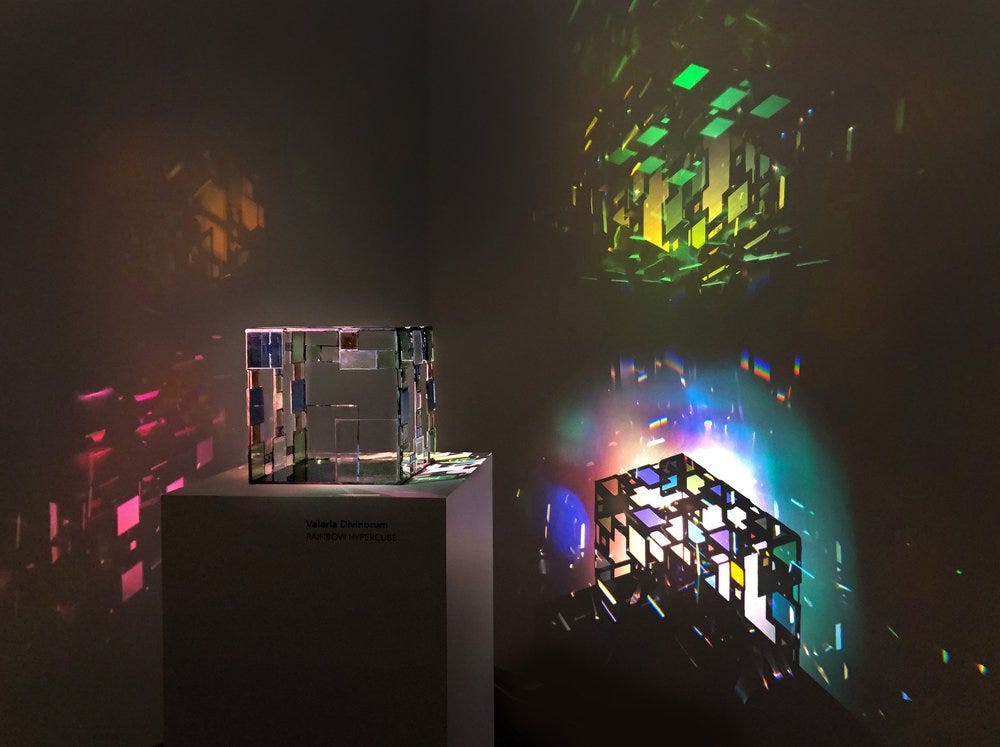
Hypercube, Stained-glass, 12 × 12 × 12 inches, 2019
PP: Is community something you value in your practice? Why or why not?
VH: I do live visuals with glass, prisms, and analog projectors in churches, galleries, and other DIY spaces. I worked as an architect in building installations and scenic architecture and I also designed ecological houses made with adobe and superadobe structures in South America.
I also teach art workshops for people of all ages from kindergarten to seniors. I have experience working for kids in self-contained classes and other public schools in The Bronx, a place where I constantly learn about the special gifts they have to create artwork.
As an immigrant artist working with immigrant communities, my mission is to bring tools and funds for materials to create significant changes in our society through art-making workshops that allow my students to expand their horizons.
PP: Do you ever work collaboratively and how so? Why or why not?
VH: This track resonates with my work. I am interested in collaborative projects with the community. The way I started making art installations back in 2012 was with a group of women with whom I co-founded an art collective named Salvia Divinorum. We upcycled material from trash and painted it with neon acrylics. Then with that material, we would create immersive installations in public spaces with LED black lights that would make the colors glow.
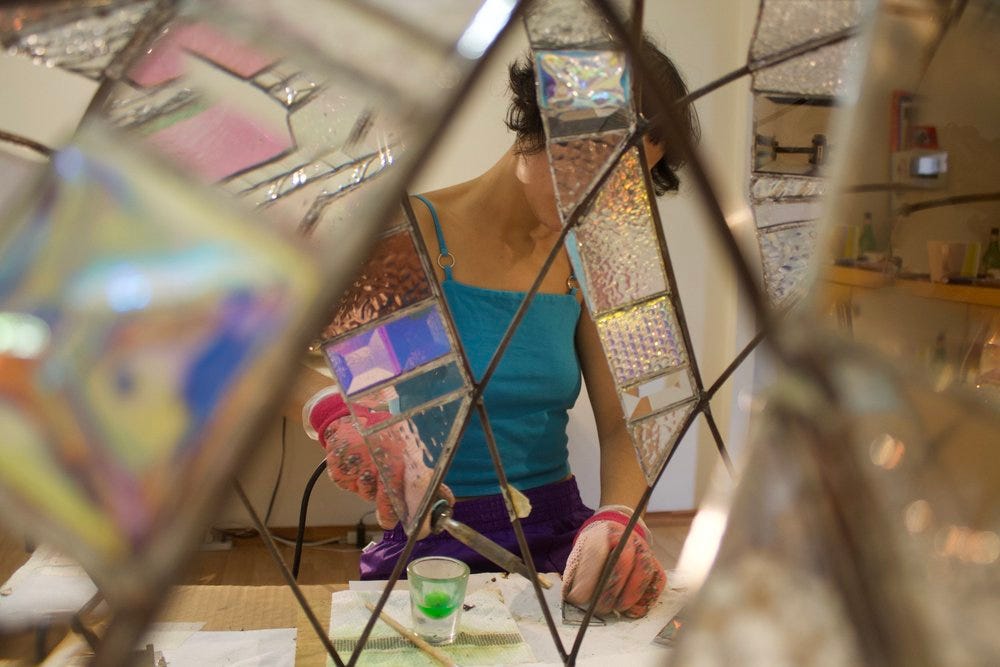
Valeria working on Spiraculum in her studio, 2023
PP: Who is a current muse for your practice? Could be anyone fictional or real, dead or alive!
VH: I find deep inspiration in the work of Olafur Eliasson: “He works in the cross-field of art and science and uses both artificial and natural light in his installations. Especially two aspects of Eliasson’s work is interesting in the eyes of LYS; One, is the fact that his work exists in the perception of the observer. He describes this experience, the moment of observing, as ‘seeing yourself sensing’. The other aspect is the use of the properties of light as a material.” – LYS article.
To learn more about Valeria’s work, see her Instagram and Website.